

Wig vs. Hair Topper for Temple and Overall Hair Thinning
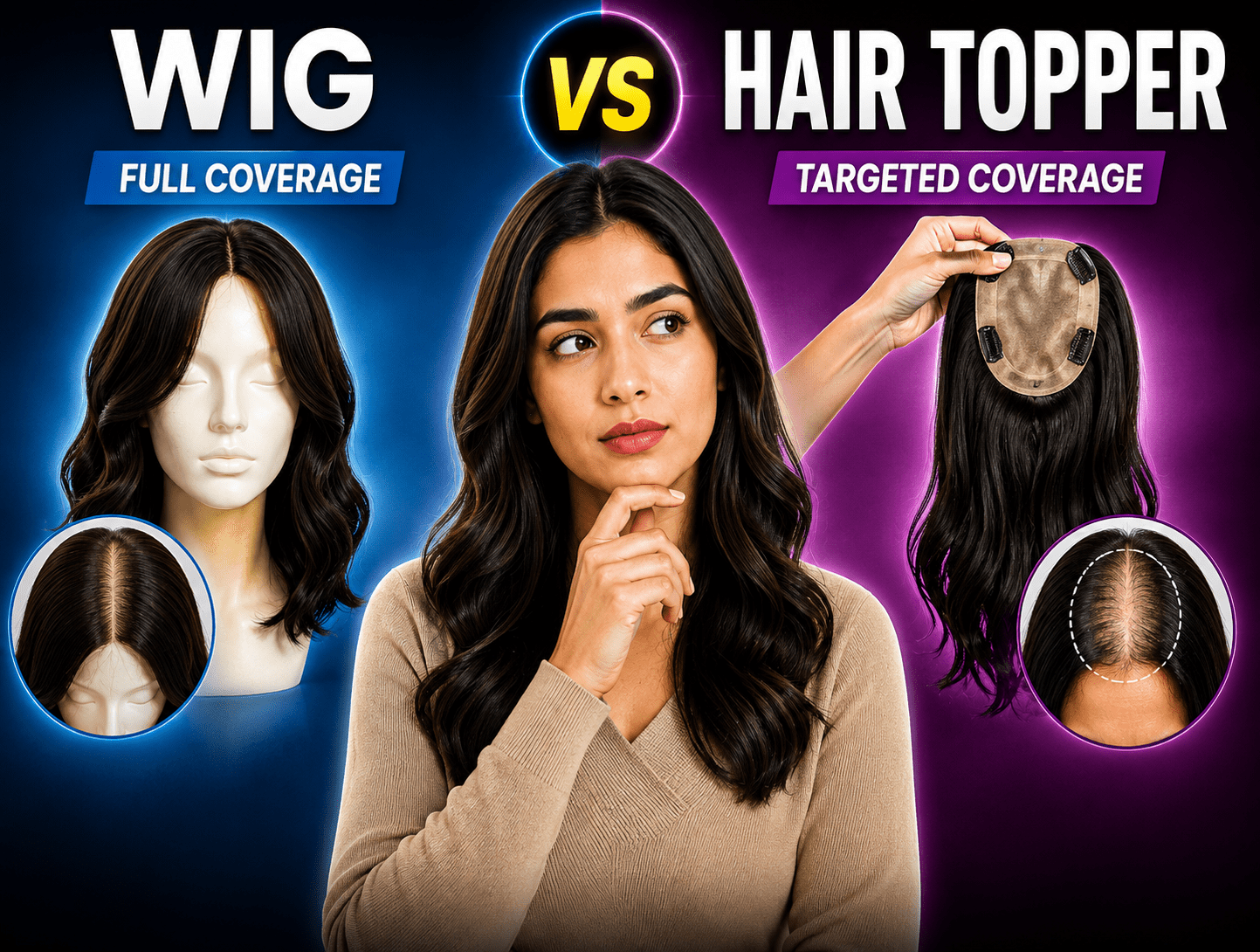
Hair thinning does not always follow the same pattern. For some women, the first noticeable change appears around the temples or front hairline. For others, density gradually decreases across the part, crown, sides, or much of the scalp. Because the area that needs coverage can vary so much, choosing between a wig and a hair topper is less about which option is universally better and more about which one matches your specific thinning pattern.
A hair topper works with your existing hair to add coverage and fullness in selected areas, while a wig provides coverage across the entire head. That distinction sounds simple, but factors such as temple coverage, remaining hair density, blending, daily styling, comfort, and how your thinning may change over time can all influence the decision. Understanding these differences can make it easier to choose a solution that feels natural and practical for your routine.
| Table of Content |
Understanding Temple Thinning vs. Overall Hair Thinning
Temple thinning refers to reduced density around the sides of the forehead, usually near the front hairline. Overall thinning is broader and may involve a widening part, reduced density across the top of the scalp, less fullness at the crown, or a generally thinner appearance throughout the hair. The American Academy of Dermatology notes that women's hair loss can appear in several patterns, including widening of the part, recession near the temples, and more widespread thinning.
Recognizing the location of thinning matters because a hairpiece can only provide natural-looking coverage when its base reaches the area you want to conceal. A topper designed mainly for the crown, for example, may provide excellent density through the top of the head but may not automatically solve significant thinning around both temples. This is why choosing by product name alone can be misleading; the actual coverage area is more important.
It is also helpful to separate cosmetic coverage from the reason your hair is thinning. Temple recession, diffuse thinning, sudden shedding, and isolated patches can have different causes. If your thinning develops rapidly, appears in distinct patches, or occurs with noticeable scalp changes, a dermatologist can help determine what may be causing it rather than relying on appearance alone.
How Hair Toppers Provide Targeted Coverage
Hair toppers are designed to sit over a selected portion of the scalp rather than covering the entire head. They are especially useful when you still have enough natural hair around and below the thinning area to blend with the added hair. This makes hair toppers for thinning hair particularly relevant to women experiencing visible scalp through the part or reduced density around the crown.
The base of the topper is one of the most important considerations. Smaller bases concentrate volume around a limited area, while larger bases can extend farther across the top and sides. If temple coverage is a priority, the shape and placement of the base become especially important because a conventional crown-focused topper may stop before reaching the areas beside the forehead.
Blending is another major part of the result. A topper does not replace all of your natural hair, so its color, texture, density, length, and direction of movement need to work with the hair that remains visible. Human hair toppers can also offer styling flexibility because the added hair can be integrated with your own hairstyle. The goal is not simply to add more hair but to create continuity between the topper and your natural hair.
Attachment also matters. Many toppers are secured to existing hair using clips, so placement should take into account where your natural hair is strong enough to support the piece comfortably. If thinning is extensive in the areas where clips would normally sit, the attachment method and base size deserve additional consideration rather than assuming every topper will fit the same way.
For women with localized top or crown thinning and reasonably good density elsewhere, a topper can preserve much of the natural hair they already have while adding targeted scalp coverage. This can make it a practical choice when full-head coverage is unnecessary.
How Wigs Provide Full-Head Coverage
A wig takes a different approach because it covers the entire scalp rather than integrating only with one thinning area. This means the front, temples, sides, top, crown, and back can all be addressed within one hair system. Wigs are commonly considered when hair loss is extensive or when a person wants consistent coverage without depending heavily on the density of their remaining hair.
For temple and hairline concerns, the front construction of the wig deserves particular attention. The way a wig is constructed can affect its fit, comfort, and overall appearance, so factors such as the cap, front edge, parting area, and size should be considered together rather than focusing only on hairstyle.
Because the wig supplies the complete hairstyle, blending with natural hair is generally less central than it is with a topper. You still need to think about color, texture, density, face shape, and the appearance you want, but you are not relying on your own hair to complete the lower sections of the style.
The tradeoff is that a full wig places a cap across more of the scalp. Some women appreciate the consistency and coverage this provides, while others with substantial natural hair may prefer to leave more of their own hair exposed. Fit and comfort therefore become important parts of the decision, especially for extended daily wear. Adjustable construction and correct sizing can help create a more secure fit.
Wig vs. Hair Topper: Key Differences to Consider
Neither option automatically produces a more natural appearance for every woman. The result depends on matching the hairpiece to your actual coverage needs, remaining hair, desired hairstyle, and routine.
Consideration |
Hair Topper |
Wig |
Coverage area |
Selected areas of the top or crown, depending on base design | Full-head coverage |
Natural hair required for blending |
Usually important | Less dependent on remaining hair |
Temple coverage |
Depends strongly on base shape and size |
Can include temples as part of full coverage |
Crown thinning |
Often well suited to targeted crown coverage | Also covers the crown |
Overall thinning |
May work when enough natural hair remains for blending | Often more practical when thinning is widespread |
Styling approach |
Integrates with natural hair | Provides the complete hairstyle |
Attachment and fit |
Depends on topper construction and available hair | Depends on wig cap construction and sizing |
Daily experience |
Leaves more natural hair exposed | Covers the entire scalp |
The most important difference is therefore not simply size. A topper depends on strategic integration, while a wig creates a complete coverage system. If your main concern is concentrated in one region, targeted coverage may be sufficient. If several areas require coverage at the same time, full-head coverage may provide a more straightforward result.
Which Option Works Better for Temple Thinning?
Temple thinning can make this comparison more nuanced because many toppers are designed primarily around the top, part, or crown. If your crown has good density but the temples are noticeably sparse, selecting a standard crown topper without examining its base shape could leave the main concern insufficiently covered.
A topper can still be suitable when the design extends into the required frontal or side areas and when there is enough surrounding natural hair for secure placement and blending. In this situation, the important question is not simply, "Can a topper cover thinning hair?" It is, "Does this particular topper base reach my temples while integrating naturally with the hair around them?"
The hairline also deserves attention. If thinning is limited to areas slightly behind the temple while the front hairline remains relatively dense, integration may be easier. If thinning affects the front hairline and both temples extensively, a full wig may offer more consistent coverage because the complete frontal appearance can be created as part of the wig rather than depending on sparse natural hair.
Temple thinning itself should not be used to determine its medical cause. Some forms of hair loss can affect the front and sides of the scalp, so noticeable progression or associated scalp symptoms are reasons to consider professional medical evaluation.
When Overall Thinning May Require More Coverage
Overall thinning changes the decision because the issue is no longer confined to one small section. You might notice a wider part, visible scalp through the top, reduced crown density, thinner sides, and less fullness through the lengths. In that situation, adding coverage to only one area can sometimes make the remaining thin areas more noticeable by comparison.
A larger scalp coverage hair topper may still work when the thinning is mainly concentrated across the upper portion of the head and enough natural hair remains around the sides and back. The larger base can distribute coverage across a broader region while still allowing the topper hair to blend with your natural lengths.
As thinning becomes more widespread, however, the amount of natural hair available for blending and attachment becomes increasingly important. If the sides, temples, top, and crown all need significant coverage, trying to solve each area through topper placement may become less practical. A wig can create balanced density across the entire hairstyle without relying on several separate areas of natural hair to complete the look.
There is no exact level of thinning at which every woman should switch from a topper to a wig. Hair density, coverage priorities, hairstyle, attachment preferences, and personal comfort all differ. Thinking in terms of coverage zones is usually more useful than trying to classify your hair loss as simply "mild" or "severe."
How to Choose Based on Your Hair Loss Pattern and Lifestyle
Start by identifying exactly where you want more coverage. Look at the front hairline, both temples, part, top, crown, sides, and back rather than evaluating your hair only from the front mirror. Photos taken from different angles can also help you understand whether the thinning is concentrated or distributed across several areas.
Next, consider how much natural hair you want to keep visible. If you like your existing length and texture and mainly want additional volume across the top, a natural looking hair topper may allow you to continue using much of your own hair. If blending several thinning areas feels difficult, a human hair wig can provide a more unified hairstyle from the hairline through the ends.
Your routine matters as well. Think about how often you plan to wear the piece, how much styling you want to do, whether you are comfortable integrating your own hair each morning, and how secure the attachment feels during a normal day. A solution that looks good but does not suit your daily routine can become frustrating over time.
Comfort should be evaluated personally rather than assumed from the category. With a topper, consider the base size, weight distribution, and attachment points. With a wig, look at sizing, cap construction, and how the piece feels around the forehead, temples, ears, and nape. Wig construction can meaningfully affect fit and comfort, particularly during longer wear.
Finally, consider whether your coverage needs are stable or changing. If only the crown currently needs coverage, a topper may provide the targeted solution you want. If thinning is progressively becoming visible across multiple areas, a broader base or full wig may make more sense from a practical coverage perspective. This is not a medical prediction; it is simply a reason to choose a hairpiece based on both your current pattern and how adaptable you want the coverage to be.
Conclusion
The choice between a wig and a hair topper depends primarily on where your thinning occurs and how much natural hair remains available for blending. A hair topper can be an effective option for targeted top or crown thinning and may also address certain temple concerns when its base is designed to reach those areas. A wig provides full head coverage and can be especially useful when thinning extends across the temples, hairline, top, crown, and other areas simultaneously.
Instead of asking which option is better in general, focus on which one covers the areas that matter to you while fitting comfortably into your everyday routine. Evaluating the thinning pattern, base coverage, blending requirements, attachment, fit, and desired hairstyle together can help you make a more informed choice.
Don’t let hair loss hold you back! Call us 📞+91 9967123333 for personalized guidance and solutions designed to meet your unique needs. Take the step toward confidence today!
You don’t have to figure this out alone.
Tell us a few details, and our caring experts will help you find the right wig for your comfort and confidence.
👉 [Fill out the form here.]
Read more
How to Choose the Right Hair Topper Density for a Natural Look
Choosing a hair topper is not simply about adding as much hair as possible. If your goal is a natural appearance, the topper needs to complement the amount, thickness, texture, and movement of the ...
Read more
Hair Extensions for Damaged Hair: Which Method Is the Safest?
Damaged hair can make permanent hair extensions feel like a risky decision. You may want fuller, healthier-looking hair, but you may also worry about breakage, thinning, or putting extra stress on ...
Read moreneed help?


Leave a comment
This site is protected by hCaptcha and the hCaptcha Privacy Policy and Terms of Service apply.