

How to Choose the Right Hair Topper Density for a Natural Look
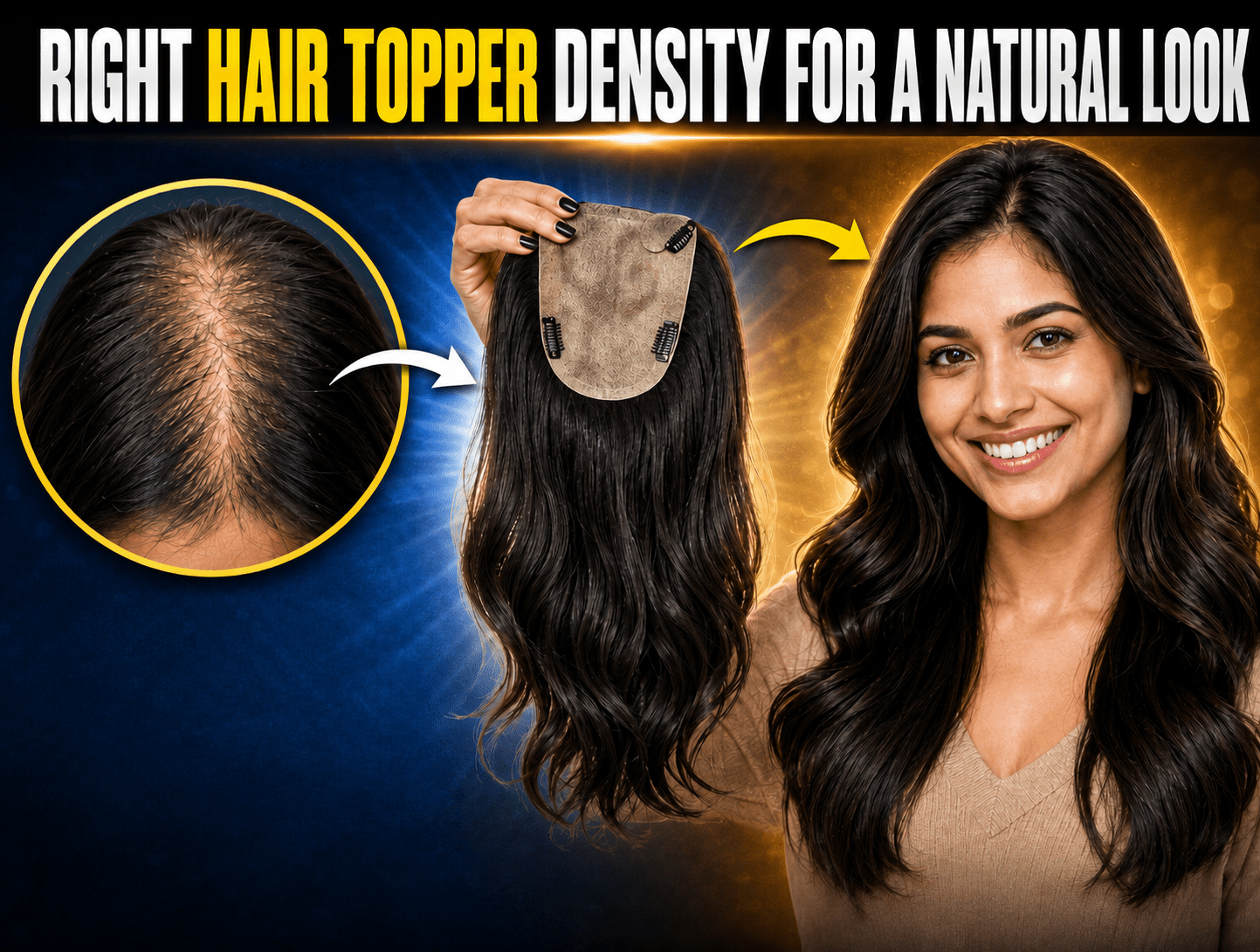
Choosing a hair topper is not simply about adding as much hair as possible. If your goal is a natural appearance, the topper needs to complement the amount, thickness, texture, and movement of the hair you already have. Density plays an important role because it determines how full the topper appears once it is positioned and blended with your natural hair.
For women experiencing thinning around the parting, top, or crown, the right density can create coverage without making the added hair look disconnected from the rest of the hairstyle. A topper that is too full may overwhelm fine or sparse natural hair, while one that is too light may not provide the coverage or volume you need. Current topper guidance consistently emphasizes matching density to existing hair rather than automatically choosing maximum fullness.
| Table of Content |
What Does Hair Topper Density Mean?
Hair topper density describes how much hair is incorporated into the topper. In practical terms, it affects whether the finished hairstyle looks light and subtle, moderately full, or noticeably voluminous. Density should not be confused with the dimensions of the topper's base. Base size determines the area of the scalp that the topper can cover, while density influences how much hair is distributed across that area.
You may see density described using terms such as low, light, medium, or fuller density. Some makers also use percentages or their own density scales. These labels are not always directly comparable across different topper designs, so a number or category should be treated as a reference point rather than the only factor in your decision.
It is also helpful to distinguish between fine hair and thinning hair. Fine hair refers to the diameter of individual strands, while thinning refers to having less hair density across an area of the scalp. A woman can therefore have fine strands without significant thinning, thicker strands with visible thinning, or a combination of both.
This distinction matters because two women with similar-looking crown thinning may need different topper densities. One may need very light added hair that matches naturally fine strands, while another may benefit from more fullness because the surrounding hair is naturally thicker.
Why the Right Density Matters for a Natural Look
A natural-looking hair topper should feel visually connected to the hair around it. When you look at the finished hairstyle, there should not be an obvious point where the topper appears dramatically fuller than the hair beneath or around it. Instead, the volume should transition gradually from the topper into your own hair.
This is why more density does not automatically create a better result. On someone with very fine or sparse hair, excessive fullness through the top can make the difference between the topper and natural hair more noticeable. Too much volume near the parting can also create a shape that does not resemble the person's usual hairstyle. Current educational guidance on toppers for fine hair similarly notes that lower density can provide a subtler blend.
At the other end of the spectrum, very low density may not provide enough visual coverage for someone with more extensive thinning. If the purpose of the topper is to cover a wider crown area or provide noticeable fullness, the selected density needs enough hair to accomplish that without creating obvious gaps.
The goal is therefore balance. Natural appearance comes from choosing enough density to address your coverage needs while keeping the overall volume compatible with your existing hair.
How to Match Topper Density to Your Natural Hair Thickness
One of the most useful starting points is to look at your natural hair away from the thinning area. Pay attention to the sides, back, and lower lengths because these sections show the density and strand thickness that the topper ultimately needs to blend into.
If your natural hair is fine and naturally lies close to the head, a lighter-density topper may create the most believable transition. Adding dramatically fuller hair at the top can make the ends of your natural hair appear comparatively thin. A lightweight hair topper can instead add targeted coverage while preserving the softer character of your existing hairstyle.
If your hair has moderate natural fullness, you may have greater flexibility. Medium density can provide visible coverage and hair toppers for volume without making the crown look disproportionately heavy. The important question is not how much volume looks impressive when the topper is viewed by itself, but how the finished piece interacts with your own hair.
Women with naturally thick hair can sometimes carry a fuller topper more easily because there is enough surrounding hair to support the added volume visually. Even then, density should still relate to the specific area being covered. Thick hair at the back does not automatically mean the crown requires maximum fullness.
Texture also changes how density appears. Straight hair tends to reveal the distribution and outline of the hairstyle clearly, while waves and curls create more visual dimension. The same amount of hair can therefore look different depending on movement, strand pattern, styling, and length.
Choosing Density Based on Thinning and Coverage Needs
Your level and location of thinning should influence density together with base size. Hair toppers for crown thinning, for example, may need to address a different area than toppers intended mainly to soften a widening part. Coverage guides commonly recommend evaluating the thinning area first and choosing a base that extends appropriately around it.
For early or localized thinning, the objective may be subtle reinforcement rather than dramatic volume. A lower-density topper can add hair around the part or crown while keeping the result understated. This approach can be particularly suitable when there is still a good amount of natural hair available for blending.
With moderate thinning across a broader section of the top, slightly greater density may be useful. The topper needs enough hair to create balanced scalp coverage while integrating with the sides and back. Base dimensions become especially important at this stage because placing a very dense topper on a base that does not appropriately cover the thinning area will not necessarily solve the underlying blending problem.
For more extensive thinning, the relationship between coverage area and density becomes even more important. A larger base can distribute hair across a wider section instead of concentrating excessive volume in a small area. This is one reason density should never be chosen in isolation.
Hair loss patterns can also change over time. If you notice new or unexplained thinning, a hair topper can offer cosmetic coverage, but it does not identify or treat the reason for the change. Questions about the underlying cause of hair loss are more appropriately discussed with a qualified healthcare professional.
How Base Size, Hair Length, and Texture Affect the Final Look
Density is only one part of the equation. A natural-looking hair topper also depends on base coverage, length, color, texture, and how well the topper integrates with the natural hairstyle. Industry guidance commonly treats these features as interconnected rather than separate decisions.
Base size affects distribution:
A small base carrying a substantial amount of hair may create concentrated volume through one area of the crown. A broader base can spread the hair over a larger area, potentially creating a more gradual transition when wider coverage is needed. The correct base should also extend appropriately around the thinning area rather than sitting entirely within sparse hair.
Length affects perceived fullness:
Longer hair creates more overall visual mass, so the same density can appear fuller on a long topper than on a shorter style. If your natural ends are relatively fine, adding a very full long topper can create an imbalance between the upper section and lower perimeter of the hairstyle.
Texture changes volume:
Straight strands often sit more compactly, while waves or curls can create additional visual fullness. Density therefore needs to be considered in combination with your natural texture rather than as an independent specification.
Color affects blending:
Even an accurately chosen density may look noticeable if the color transition is obvious. Natural hair frequently contains more than one tone, so matching the overall depth, warmth, and distribution of color can be just as important as matching fullness.
Human hair toppers can also offer styling flexibility, which can help the topper integrate with your own hairstyle when handled appropriately. The objective is to make the topper and natural hair move as one overall style rather than looking like two separate sections.
Common Hair Topper Density Mistakes to Avoid
A frequent mistake is assuming that the fullest topper will provide the most natural result. Fuller hair can be appealing, especially when thinning has affected confidence, but natural-looking hair toppers usually depend on proportion. If the difference between the topper and your natural hair is too dramatic, additional volume can actually make blending more difficult.
Another mistake is choosing density without considering base size. Density addresses the amount of hair, while the base determines where that hair sits. If the base does not correspond well with the thinning area, increasing density alone may not create the desired coverage.
It is also easy to focus only on the crown when evaluating the finished look. Your topper needs to make sense with the sides, back, and ends as well. Check the hairstyle from several angles and notice whether the top looks significantly fuller than the rest of your hair.
Other practical mistakes include:
- Selecting density based only on photographs of the topper by itself.
- Ignoring your natural strand thickness and texture.
- Choosing extra fullness when your main need is scalp coverage.
- Overlooking how the topper's length affects perceived volume.
- Expecting styling alone to correct a major density mismatch.
- Assuming density terminology is identical across every topper design.
The most useful comparison is always the topper against your own hair. A density that looks subtle on one person can appear much fuller on someone with finer or sparser natural hair.
How to Create a Seamless Blend with Your Natural Hair
Once the density is appropriate, blending determines how convincing the final result feels. Begin by positioning the topper so its coverage corresponds naturally with the area of thinning. The surrounding natural hair should support a gradual visual transition rather than creating a sharp contrast between dense and sparse sections.
The parting also deserves attention because it is one of the first areas people notice. Aligning the topper's part with the direction in which you normally wear your hair can make the style feel more familiar. A dramatic change in part position, density, and volume at the same time may make the result feel less like your usual hair.
Length should be blended into the natural perimeter rather than simply matched by measurement. If the topper is much fuller through the ends than your own hair, shaping or professional customization may help create continuity. The purpose is not to remove all of the added volume but to prevent the topper from ending as a visibly separate layer.
Styling should also respect your natural texture. If your hair has soft waves, styling the topper into a similar pattern can help distribute the added volume. If your hair is straight, maintaining a compatible finish can keep the overall silhouette cohesive.
Finally, assess your topper in everyday conditions. Look at it in natural light, check it from the sides and back, and observe how it behaves when you move. Density that looks balanced from the front should also appear proportional through the crown and lengths.
The right hair topper density should give you the coverage you need without becoming the most noticeable part of your hairstyle. When density, base size, length, texture, and color work together, the result can look much more integrated and personal.
Conclusion
Choosing hair topper density is less about finding a universal level of fullness and more about matching the topper to your own hair. Your natural strand thickness, existing density, thinning pattern, coverage area, base size, length, and texture all influence whether the finished hairstyle looks balanced.
For women exploring hair toppers for thinning hair, a thoughtful match usually creates a more natural result than simply choosing the maximum amount of hair. Focus on proportion, coverage, and blending, and evaluate the topper as part of your complete hairstyle rather than as a separate piece.
Take the first step toward confident hair today! 📞 +91 9967123333 Call us for a personalized consultation and discover the most effective solution for your hair needs.
Hair thinning on top? Feeling conscious in photos or at work?
You’re not alone — and we’re here to help.
👉 [Fill this form and get guidance on choosing the right topper.]
Read more
Why Wig Customization Makes Such a Big Difference
A wig may look beautiful in the display and still feel very different when you wear it. It often comes down to the details of the fit, the hairline placement, the density, the parting, the color, t...
Read more
Wig vs. Hair Topper for Temple and Overall Hair Thinning
Hair thinning does not always follow the same pattern. For some women, the first noticeable change appears around the temples or front hairline. For others, density gradually decreases across the p...
Read moreneed help?


Leave a comment
This site is protected by hCaptcha and the hCaptcha Privacy Policy and Terms of Service apply.